
Sustainable Product Materials: The 2026 Guide to Conscious Shopping
What if that "100% compostable" phone case you feel so good about is destined to release methane in a landfill for the next 50 years? It's a frustrating feeling, and you're not alone. A 2023 report by the Changing Markets Foundation revealed that nearly 60% of green claims made by major brands were unsubstantiated. You spend extra money and effort to make a better choice, only to discover you've been tricked by clever marketing, leaving you second-guessing every purchase.
This 2026 guide is here to change that. We're cutting through the greenwashing to give you a simple, science-backed framework for evaluating sustainable product materials. You'll master the art of identifying truly eco-friendly products, learn exactly which certifications to trust, and gain the power to sidestep the greenwashing trap for good. Get ready to decode the items in your shopping cart, from recycled plastics to innovative biomaterials, and finally shop with total confidence.
Key Takeaways
- Learn why the definition of 'sustainable' is shifting from simply "less bad" to truly restorative and regenerative materials by 2026 standards.
- Discover the surprising reasons why some recycled synthetics can have a lower environmental impact than conventional natural materials like cotton.
- Go beyond basic wood and cotton to understand the next wave of sustainable product materials, including innovative options like mycelium, algae, and post-consumer recycled content.
- Quickly identify greenwashing red flags and learn which eco-certifications like GOTS and Cradle to Cradle actually guarantee a product's claims.
What Makes a Material Truly Sustainable in 2026?
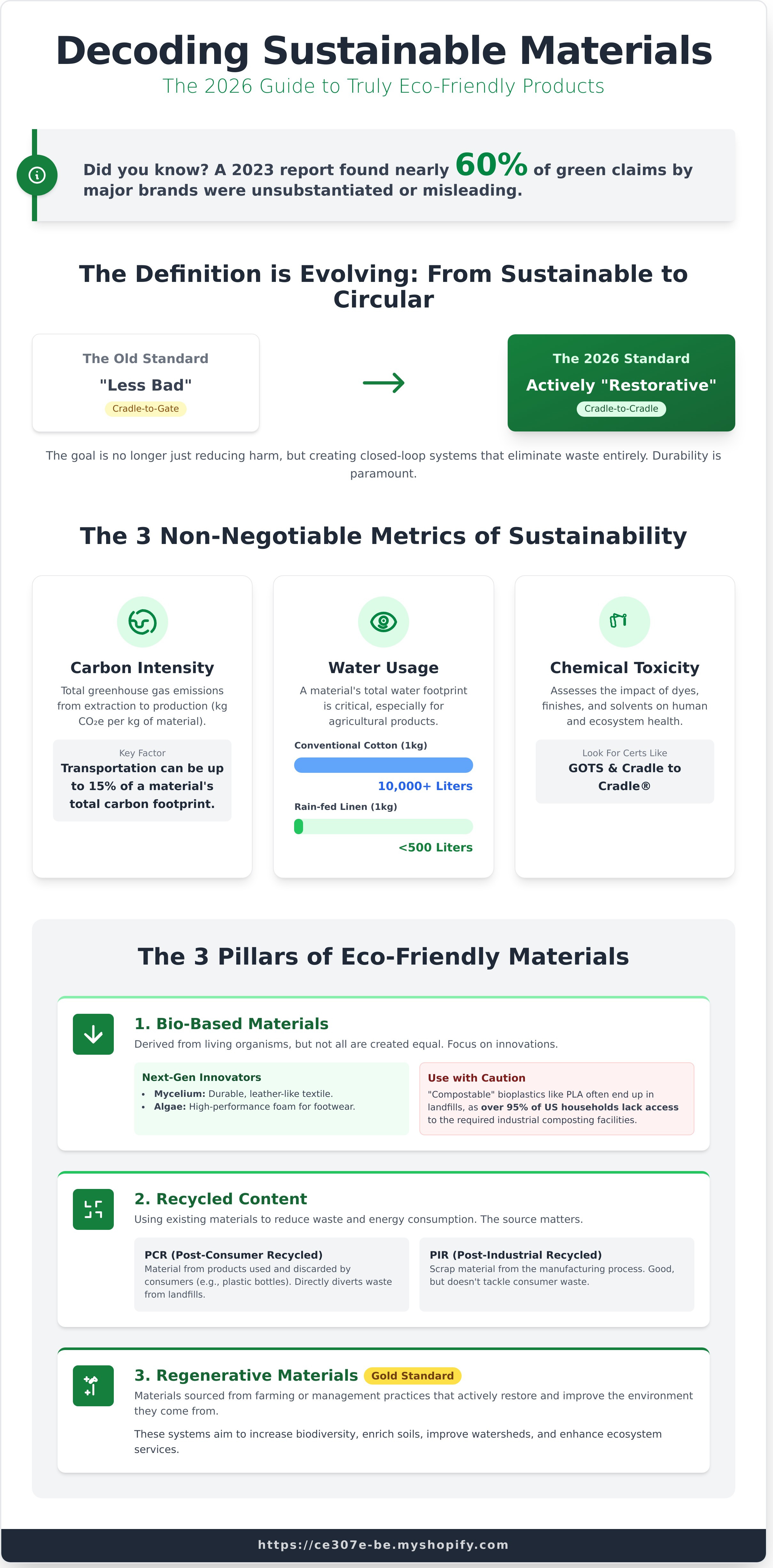
The term "sustainable" has been stretched, twisted, and often greenwashed. What was considered a gold standard in 2020, like using recycled plastics, is now just the entry fee. By 2026, the definition of a sustainable material has fundamentally shifted from doing "less bad" to being actively "restorative" or "regenerative." It’s no longer enough for a material to simply be recyclable; it must be part of a system that actively improves the environment. This evolution is driven by a much deeper understanding of a material’s true impact, moving beyond surface-level claims to a data-driven approach.
This comprehensive view is the core of Sustainable Materials Management, a framework that evaluates materials not in isolation but as part of an integrated system. To do this, we now lean on three core, non-negotiable metrics that paint a complete picture of a material's footprint:
- Carbon Intensity: Measured in kilograms of CO2 equivalent (kg CO2e) per kilogram of material, this reveals the total greenhouse gas emissions from extraction to production.
- Water Usage: A material’s water footprint is critical. For example, producing one kilogram of conventional cotton can consume over 10,000 liters of water, while rain-fed linen requires less than 5% of that amount.
- Chemical Toxicity: This metric assesses the impact of dyes, finishes, solvents, and other processing agents on both human health and aquatic ecosystems, ensuring a material is safe throughout its life.
The Life Cycle Assessment (LCA) Explained
A Life Cycle Assessment (LCA) is a holistic measurement of a material's environmental impact, from raw material extraction through manufacturing and use to its final disposal or recycling. The old "cradle-to-gate" analysis, which only measured impact until a product left the factory, is now seen as incomplete. The 2026 standard demands a "cradle-to-grave" or, ideally, a "cradle-to-cradle" perspective, because a product's end-of-life phase can determine whether it becomes waste or a resource for something new. Transportation alone can account for up to 15% of a material's total carbon footprint, proving that where a material comes from matters just as much as what it's made of.
The 2026 Standard: Circularity vs. Sustainability
The conversation has moved beyond sustainability to circularity. While sustainability aims to reduce negative impacts, circularity aims to eliminate waste entirely by creating closed-loop systems. This is why durability has become a key pillar; a highly durable polypropylene container designed for 500+ uses is vastly superior to a single-use "compostable" bioplastic cup that contaminates recycling streams. The most sustainable product materials are often those that last the longest. Propelled by regulations like the EU's Digital Product Passports, the 2026 landscape demands radical transparency, forcing companies to disclose every step of their material sourcing and manufacturing process.
The 3 Pillars of Eco-Friendly Materials: Bio-based, Recycled, and Regenerative
Choosing the right material isn't just about picking one that sounds green. It's about understanding the entire lifecycle and impact. This complex decision-making is a core part of a larger strategy, which the U.S. Environmental Protection Agency calls Sustainable Materials Management (SMM). To simplify this, we focus on three key pillars that guide our selection of sustainable product materials: bio-based, recycled, and the gold standard, regenerative.
Modern Bio-based Innovations
Bio-based materials, derived from living organisms, are evolving far beyond traditional wood and cotton. We're now seeing incredible innovations like mycelium, the root structure of mushrooms. Companies like MycoWorks are transforming it into a durable, leather-like textile that's projected to become a staple in consumer fashion by 2026. At the same time, algae is being turned into high-performance foams by innovators like BLOOM, replacing petroleum-based EVA in footwear and packaging. But not all bio-plastics are created equal. Many "compostable" plastics like PLA require industrial composting facilities operating above 140°F to break down, a service unavailable to over 95% of American households. Without it, they contaminate recycling streams or end up in landfills.
The Power of Recycled Content
Using materials that already exist is a powerful way to reduce waste and energy consumption. It’s crucial, however, to distinguish between two types of recycled content:
- PCR (Post-Consumer Recycled): This material comes from products that have been used and discarded by consumers, like a plastic water bottle or an aluminum can. Using PCR directly diverts waste from landfills.
- PIR (Post-Industrial Recycled): This is scrap material recovered from the manufacturing process itself, like textile cut-offs. While good, it doesn't tackle the consumer waste problem.
The material itself also matters. Metals like aluminum and glass can be recycled almost infinitely without losing quality. Most plastics, however, degrade with each cycle; a PET bottle can typically only be recycled into a new bottle once or twice before it must be downcycled into a lower-quality product like carpeting. To ensure you're getting what's advertised, look for certifications like the Global Recycled Standard (GRS), which verifies recycled content claims from start to finish.
Finally, we have regenerative materials, which represent the pinnacle of sustainability. These materials come from sources that actively improve the environment. Think regenerative agriculture, where farming practices like no-till and cover cropping sequester carbon in the soil, increase biodiversity, and improve the water cycle. This approach doesn't just sustain the ecosystem; it heals it. Our hierarchy of choice is clear: we prioritize regenerative materials first, followed by high-PCR recycled content, and then responsibly sourced, innovative bio-based materials. Navigating these options is a constant journey, and you can see these principles in action by exploring our current material selections.
Natural vs. Synthetic: Comparing the Real Environmental Impact
It’s easy to fall into the "natural is better" trap. We picture pristine fields and happy animals, but the reality is often far more complex. The journey to create truly sustainable product materials requires looking beyond the label and examining the entire lifecycle of a product. A prime example is conventional cotton. Producing the cotton for just one t-shirt can consume up to 2,700 liters of water and relies on farming that accounts for 16% of global insecticide use. In contrast, a high-quality recycled polyester (rPET) diverts plastic bottles from landfills and uses over 50% less energy than its virgin counterpart.
This isn't a simple case of good vs. evil. It’s about making informed choices based on data. Evaluating the full environmental cost, from raw material extraction to end-of-life disposal, is the core principle of what the U.S. Environmental Protection Agency outlines in its Sustainable Materials Management Basics. This holistic view reveals that the most impactful part of a material’s footprint is often hidden in its processing.
The Hidden Cost of Natural Fibers
Beyond the shocking water and pesticide footprint of conventional cotton, other natural fibers carry their own baggage. The leather industry, for instance, often uses chromium-6 in its tanning process, a carcinogen that can pollute waterways. Wool production can involve practices like mulesing, a painful procedure for sheep. That’s why we believe third-party certifications are non-negotiable. The Global Organic Textile Standard (GOTS) is our baseline; it guarantees not only the organic status of textiles but also enforces strict social and ecological criteria throughout the entire supply chain, from harvesting to manufacturing.
Advanced Synthetics and Lab-Grown Alternatives
Innovation is rapidly closing the gap between nature and the lab, creating a new class of high-performance, low-impact materials. We're inspired by companies creating bio-fabricated materials that mimic nature with incredible precision. Think of leather grown from mushroom mycelium (like Mylo™) or silk proteins produced through fermentation, completely removing animals from the equation. At the same time, recycled synthetics are turning pollution into a solution. Materials like ECONYL® regenerated nylon are made from 100% waste, including discarded fishing nets pulled directly from the ocean, reducing the global warming impact of nylon by up to 90% compared to virgin sources.
This forward-thinking approach also means phasing out harmful chemicals. By 2026, sweeping regulations in the EU and U.S. states like California will effectively ban the use of PFAS, or "forever chemicals," in most textiles. These chemicals, long used for water and stain resistance, persist in the environment indefinitely. We are committed to using PFAS-free finishes well ahead of these regulatory deadlines.
Of course, the conversation around synthetics must address microplastics. It's a serious issue. When washed, synthetic garments can shed tiny plastic fibers that enter our waterways. While we prioritize recycled and innovative synthetics, we also empower you to be part of the solution. Using a specialized laundry bag, like a Guppyfriend, can capture over 90% of these microfibers during a wash cycle, preventing them from polluting our ecosystems. It’s a small step that makes a massive difference in the long-term impact of your wardrobe.
How to Identify Sustainable Materials and Avoid Greenwashing
Making conscious choices feels great, but the market is flooded with misleading claims. Brands use vague, feel-good words to create a green illusion, a practice known as greenwashing. A 2021 European Commission study found that 42% of online corporate environmental claims were exaggerated, false, or deceptive. You can become a smarter shopper by learning to spot the red flags and recognize the signs of true commitment.
Your first line of defense is skepticism towards fuzzy language. Watch out for these common greenwashing tactics:
- Vague Terms: Words like "eco-friendly," "green," "earth-friendly," or "natural-ish" mean absolutely nothing without proof. They are marketing fluff, not a certification.
- Hidden Trade-Offs: A product might be promoted as "made with recycled plastic" while ignoring the toxic dyes or unethical labor used in its production. True sustainability considers the entire lifecycle.
- Irrelevant Claims: Touting a product as "CFC-free" is meaningless, as chlorofluorocarbons have been banned by law in aerosols since the late 1970s.
Reading the Fine Print: A Shopper's Cheat Sheet
Labels can be tricky. A tag saying "contains 20% recycled polyester" is a start, but it also means 80% is virgin plastic. And don't be fooled by the "Green Dot" symbol; it doesn't mean the packaging is recyclable. It only signifies that the producer made a financial contribution towards packaging recovery. For real verification, use public databases like the GOTS certified suppliers database or the B Corp Directory to check if a brand's claims hold up.
The Role of Certifications in 2026
As we move towards 2026, third-party certifications are your most reliable tool for identifying genuinely sustainable product materials. They provide independent verification that a product meets rigorous environmental and social standards. Think of them as a universal language for sustainability.
- FSC (Forest Stewardship Council): For wood and paper, look for FSC 100% (best), FSC Mix, or FSC Recycled. This ensures responsible forest management.
- OEKO-TEX vs. GOTS: For textiles, these are different. OEKO-TEX STANDARD 100 certifies that a product is free from a list of over 350 harmful substances. GOTS (Global Organic Textile Standard) goes further, requiring at least 70% organic fibers and ensuring ethical social criteria are met throughout the supply chain.
- B Corp & Fair Trade: These certifications look beyond materials to the company itself. B Corp assesses a company's entire social and environmental performance, while Fair Trade guarantees fair prices and better working conditions for farmers and workers.
Soon, you won't even need to just trust the label. The EU's Digital Product Passport initiative, rolling out from 2026, will allow you to scan a QR code with your phone to instantly access detailed information on a product's material origin, composition, and repairability. This level of transparency will be a game-changer.
Ultimately, the most sustainable choice is often the one you don't have to replace. Investing in high-quality, durable materials reduces waste and consumption over time. It's a shift from viewing price as a one-time cost to understanding value as a long-term investment in a product that lasts. By choosing well-made items with transparent sourcing, you're not just buying a product; you're supporting a more responsible system. Explore our collection built on these principles of transparency and durability.
Building a Circular Future: Sourcing for the [Client] Collection
Our journey doesn’t end when a product is made. It begins there. We believe that true sustainability is rooted in transparency, not marketing buzzwords. While terms like "eco-friendly" and "green" have become diluted, our commitment is to provide you with a clear, honest look at the entire lifecycle of our products. This means moving beyond a linear "take-make-waste" model and embracing a circular system where every material has a future.
For our 2026 collection, we developed a rigorous four-point vetting process for every component we consider. This isn't just a checklist; it's our foundational promise to you. We analyze how each material is created, used, and what happens to it when you're done. It's how we ensure we're using the best sustainable product materials available today.
- Life Cycle Assessment (LCA): We require LCA data from our suppliers, evaluating water usage, carbon emissions, and energy consumption from raw material extraction to final processing. Our goal for 2026 was to select materials that score at least 40% better on key environmental metrics than their conventional counterparts.
- Third-Party Certification: Every material must carry a recognized certification. This includes the Global Recycled Standard (GRS) for recycled content, Forest Stewardship Council (FSC) for wood and paper, and OEKO-TEX for textile safety.
- End-of-Life Plan: We prioritize materials that are either biodegradable in a home compost environment within 180 days or are easily recyclable in at least 75% of municipal systems.
- Ethical Sourcing: Our suppliers must adhere to strict fair labor standards, verified through audits conducted by organizations like Fair Wear Foundation.
This commitment extends right to your doorstep. From unboxing to potential returns, your entire experience is plastic-free. We use FSC-certified cardboard boxes, water-activated paper tape, and cornstarch-based protective fillers that dissolve in water. Your purchase directly supports this infrastructure, helping us invest in suppliers and technologies that are building a truly regenerative economy, one package at a time.
Our Launch Collection: Materials in Focus
Our 2026 grand opening collection showcases these principles in action. Our bestseller, our signature Weekender Bag, is crafted from 92% GRS-certified recycled sailcloth, giving a durable, water-resistant material a second life. The accents are made from MIRUM®, a 100% bio-based and plastic-free leather alternative. We chose these components not just for their low impact, but for their exceptional performance and longevity. Shop New Collection to see these incredible materials for yourself.
Join Our Mission
We know the world of sustainable product materials is constantly evolving, and so are we. Our plan is to increase our use of bio-based components to over 50% of our total material volume by 2028. Your feedback is a critical part of this journey. Let us know what you love and what you want to see next. Together, we can shape a more responsible future. Sign up for our newsletter to get 15% off your first order and follow our progress.
Step Into a Circular Future with Confidence
You're now equipped to look beyond simple marketing claims. You understand that true sustainability isn't just one thing; it rests on the three pillars of bio-based, recycled, and regenerative sourcing. This knowledge is your best defense against greenwashing, empowering you to identify truly sustainable product materials and make choices that align with your values.
Ready to put this knowledge into action? We've already done the homework. Every product in our collection has been meticulously vetted against our 2026 circularity standards, ensuring it meets the future of environmental responsibility. Shop our curated collection of sustainably sourced products today and enjoy a launch exclusive 15% off your first order.
This isn't just shopping. It's a powerful statement for the future you want to build. We’ll back up your commitment by shipping your entire order using 100% plastic-free materials. Let's create a circular world, together.
Frequently Asked Questions
Is bamboo actually a sustainable material?
Yes, but its sustainability depends heavily on how it's processed. Bamboo as a plant grows incredibly fast, sometimes up to 91 cm per day, without pesticides. However, turning it into soft fabric often involves a toxic chemical process to create viscose rayon. For a truly sustainable option, look for mechanically processed bamboo linen or products with certifications like the Forest Stewardship Council (FSC) to ensure it was sourced and processed responsibly.
What is the most eco-friendly fabric for clothing in 2026?
There isn't one single "best" fabric, but top contenders for 2026 include organic hemp, recycled cotton, and linen. Hemp is a standout because it requires approximately 50% less water per season than conventional cotton and produces 250% more fiber per acre. Likewise, recycled cotton certified by the Global Recycled Standard (GRS) diverts waste from landfills and saves thousands of liters of water per garment, making it a powerful circular choice.
Are bio-plastics better for the environment than regular plastics?
Bio-plastics can be better, as they reduce our reliance on fossil fuels by using plant-based sources like corn starch. However, their environmental benefit hinges on proper disposal. Many common bio-plastics, such as PLA, only break down in industrial composting facilities operating above 58°C. They won't decompose in a backyard compost bin and can contaminate the recycling stream if mixed with traditional plastics, so their end-of-life impact is critical.
How can I verify if a product is truly made from recycled materials?
The best way to verify a claim is to look for independent, third-party certifications on the product's tag or website. Don't just take the brand's word for it. Trustworthy certifications like the Global Recycled Standard (GRS) and the Recycled Claim Standard (RCS) audit the supply chain to confirm the exact percentage of recycled content. The GRS, for example, requires a minimum of 20% certified recycled material to carry its label.
Does "biodegradable" mean I can compost it at home?
No, "biodegradable" does not mean it's home compostable. The term simply means a material can be broken down by microbes over time, which could take decades or centuries in a landfill. For home composting, you need to look for a specific certification like "TÜV AUSTRIA OK compost HOME." This label guarantees the product will decompose in a typical backyard compost pile within 12 months under normal temperature and humidity conditions.
What are Digital Product Passports and how do they help shoppers?
A Digital Product Passport (DPP) is a scannable digital record that transparently details a product's entire lifecycle, from raw materials to repairability and recycling information. Mandated by the EU's ESPR regulation starting around 2026 for certain industries, DPPs empower you to make informed decisions. By scanning a QR code, you'll get verifiable data on a product's environmental impact, composition, and circularity, cutting through vague marketing claims.
Why is recycled polyester controversial in sustainable fashion?
Recycled polyester (rPET) is controversial because, while it diverts plastic bottles from landfills, it still sheds microplastics into our waterways with every wash. A 2016 study from Plymouth University found a single 6kg wash load of polyester fabrics could release an estimated 700,000 fibers. Critics also argue that it's a form of downcycling, as a plastic bottle that could be recycled back into a bottle is instead turned into fabric that cannot be easily recycled again.
What should I look for on a label to avoid greenwashing?
To avoid greenwashing, you should ignore vague, undefined terms like "eco-friendly," "green," or "natural." Instead, look for specific, quantifiable claims backed by third-party certifications. Trusted logos from groups like GOTS (Global Organic Textile Standard), Fair Trade, and FSC (Forest Stewardship Council) are reliable indicators. If a brand discusses its sustainable product materials, it should provide data, like "made with 95% GRS-certified recycled cotton," not just buzzwords.